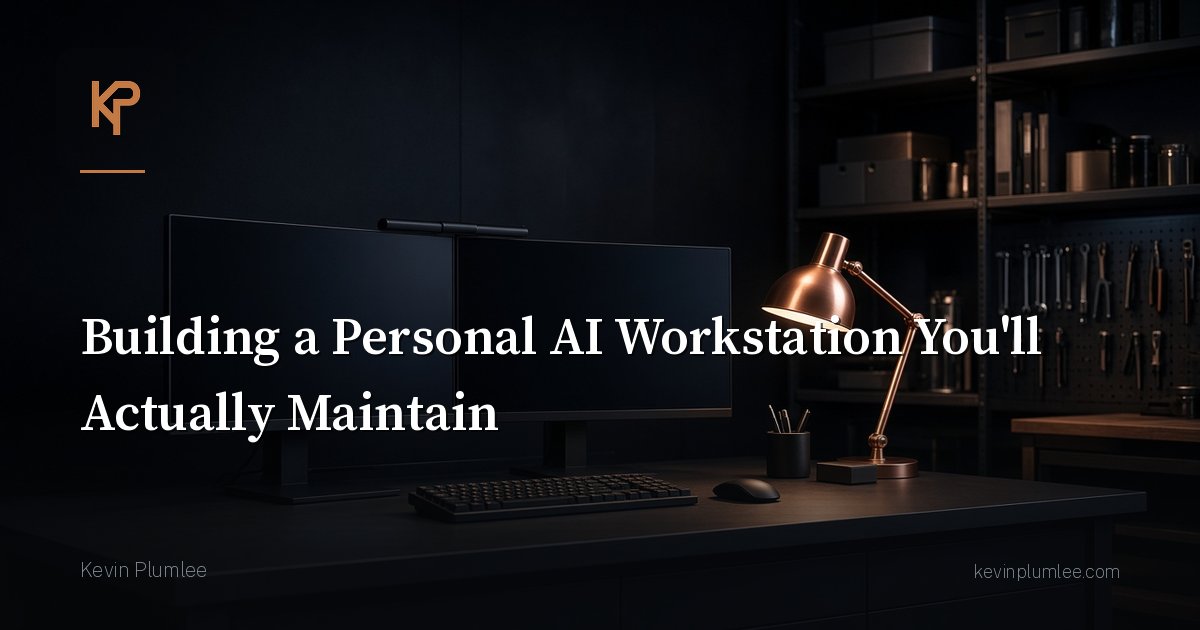
Prefer a good homelab fantasy as much as the next 42-year-old with too many browser tabs. Rack diagram. GPU glow. Local models for everything. Stickers.
Then life happens. The fancy box becomes a space heater you feel guilty about, and you are back on a cloud API from your laptop like a normal person.
The goal is not maximum FLOPs. The goal is a workstation you will still use in three months.
Decide what “local” is for
Be honest about the jobs:
- private docs and client-adjacent notes you do not want floating around
- coding agents that need fast iteration on your repo
- experimentation with models and prompts
- offline capability when travel Wi-Fi is a rumor
If your daily driver work is fine on a hosted API with a BAA and good logs, do not martyr yourself on a 24/7 GPU bill to feel pure.
Run hybrid on purpose. Local for sensitive or high-churn work. Cloud for heavy or bursty jobs.
Hardware that matches the jobs
You do not need a data center under the desk.
A practical personal setup for you looks like:
- a machine with enough RAM that embeddings and modest models do not swap themselves to death
- a GPU if you actually run local weights weekly (if not, skip it and stop cosplaying)
- fast SSD storage for models and vector indexes
- UPS if you hate corrupted indexes and angry filesystems
- backups you have restored at least once
If you have not restored a backup, you have a hope drive, not a backup.
Software you keep boring on purpose
My maintenance rule: fewer moving parts than my ambition wants.
Typical stack:
- Docker for anything that smells like a service
- one local model runner I already know
- one notes or doc pipeline into a searchable store
- one coding agent workflow wired to the repo
- Prometheus or even simple health scripts if something must stay up
Avoid “twelve AI apps that all want to be the launcher.” Launchers multiply. Attention does not.
The maintenance calendar that saves the project
Sunday is not for reinventing the motherboard.
I block 30 minutes a week:
- update containers
- check disk use (models expand like laundry)
- confirm backups ran
- delete unused weights you downloaded for a tweet
- glance at logs for auth failures and retry storms
If a component needed heroics twice in a month, I either automate the fix or remove the component. Heroics are a smell.
Privacy without paranoia theater
Local is not automatically safe. It is differently unsafe.
Still do:
- disk encryption
- separate accounts for experiments vs family machine duties
- no “chmod 777” shortcuts on data directories
- clear rules for what data never leaves the box
- API keys in env or a secret manager, not in shell history sermons
Also: know which cloud calls your “local” GUI still makes. Some tools phone home for features. Read the docs before you park sensitive text there.
A workstation workflow that earns its space
Mine earns rent when it:
- indexes project notes and SOPs I can query while building
- runs a coding agent against repos with my conventions
- keeps a small eval harness for prompts Focus on
- can draft and critique without pasting private stuff into a random website
If it only exists to generate funny images at 2am, call it a hobby box and budget it like one. No shame. Just honesty.
Cost sanity
Track:
- electricity for always-on boxes
- cloud burst spend
- your hours spent babysitting
A local setup that costs you a workday per month in fiddling is more expensive than a hosted plan you barely notice. Operators optimize for shipped work, not for winning purity contests on forums.
Start smaller than the YouTube thumbnail
Week one: one machine, one model runner, one doc folder indexed, backups on.
Week two: wire the coding agent.
Week three: only then consider always-on services and fancy dashboards.
Complexity is a loan. Interest is paid in evenings.
Bottom line
Build a personal AI workstation you can explain in one paragraph. Maintain it with a tiny weekly ritual. Let cloud handle the spikes. You will get 80 percent of the benefit with 20 percent of the regret, which is the only homelab math that still works when you also have a job and a life.